Thursday, November 10, 2011

Urban sprawl - making problems or providing solutions ?


the KL city, the CBD
source from www.skycrapercity.com
was inspired by the posts on planetizen while I was searching for a topic. The Urban Sprawl was one of the top 10 planning issues in 2002 according to Planetizen. In many countries in the world, urban sprawl has always been a problem especially for countries with rapid growth of the city and many poor migrant from the countryside to the city. Effects to be able to live in cities, migrants have to work even as informal workers, and on the other hand, the need for enforcement of regulations  for the city manager, the urban sprawl that should be organized in accordance with the plan. The question is whether urban sprawl is currently running with good management or not? Does the plan will be sustainable and benefit the future generation? Does urban sprawling become a way to solve the problems of the increasing population, the development needs of a city etc. or it is making more problems ? In this blog, I'm going to discussing and sharing about these questions above on urban sprawl with taking cases of cities in Malaysia. 


  • How to define Urban Sprawl ? 

One of the earliest uses of the word "sprawl" in terms of land use was in a 1937 speech by Earle Draper, then director of planning for the Tennessee Valley Authority: "Perhaps diffusion is too kind of word ... In bursting its bounds, the city actually sprawled and made the countryside ugly ..., uneconomic in terms of services and doubtful social value."


 "Urban sprawl, also known as suburban sprawl, is a multifaceted concept, which includes the spreading outwards of a city and its suburbs to its outskirts to low-density and auto-dependent development on rural land, high segregation of uses (e.g. stores and residential), and various design features that encourage car dependency."  SprawlCity.org


"Urban sprawl is generally defined as the increased development of land in suburban and rural areas outside of their respective urban centers. This increased development of real estate in the outskirts of towns, villages and metropolitan areas is quite often accompanied by a lack of development, redevelopment or reuse of land within the urban centers themselves."  definition of sprawl


"The unplanned, uncontrolled spreading of urban development into areas adjoining the edge of a city." The American Heritage® Dictionary of the English Language, Fourth Edition copyright ©2000 by Houghton Mifflin Company. Updated in 2009. 


Noted policy analyst Anthony Downs, at a May 1998 Transportation Research Conference, identified ten "traits" associated with sprawl:

  • unlimited outward extension
  • low-density residential and commercial settlements
  • leapfrog development
  • fragmentation of powers over land use among many small localities
  • dominance of transportation by private automotive vehicles
  • no centralized planning or control of land-uses
  • widespread strip commercial development
  • great fiscal disparities among localities
  • segregation of types of land uses in different zones
  • reliance mainly on the trickle-down or filtering process to provide housing to low-income households 


《 URBAN SPRAWL 》
source from youtube


Sunday, October 30, 2011

PROJECT 4 - PLANNING STUDENT ASSEMBLY (PSA)

Planning Student Assembly 2011 is the continuation of a tradition which is held annually at different universities which offered courses in urban planning. The aim of the event is to encourage planning students from various universities to get to know each other and forge closer interaction through various activities which are held in the event.


The theme for PSA 2011 event is Living Heritage: a Sustainable Legacy. The theme is chosen as an appreciation towards Penang, in particular George Town which has been listed as a World Heritage Site by United Nations Educational, Scientific and Cultural Organization (UNESCO) along with Melaka. George Town exhibits a great example of a city which was founded with influences from people of various backgrounds from all over the region and beyond. Such influences continue to survive until today in the forms of architecture and culture which come to define Penang and Malaysia in general.


PSA2011 aims to encourage planning students to look back at our earlier founded cities like George Town as an inspiration for creating sustainable cities for today and tomorrow. The understanding of planning is required in order to embark on the correct path for the rest of journey. Before this transit process can take place, actor should transport themselves to the past in order to move into future.


5 University involve in PSA including USM, except USM got UITM, Shah Alam, UITM,Seri Iskandar, UIAM,  UTM, and also POLIMAS.This is good chance for us to learn and understand what has others university done and they comment to us. besides that, this is also a big chance for us to learn how to organize the event from start until end


Monday, October 3, 2011

PROJECT I -- draft site analysis (kampung setol)

Project 1 - Spatial Design and Costing
Students select an area of study and prepare of study and prepare a site analysis of the area. Based on the site analysis, students propose a concept plan and a layout plan of a community interactive space, which includes elements of design, landscape and costing.

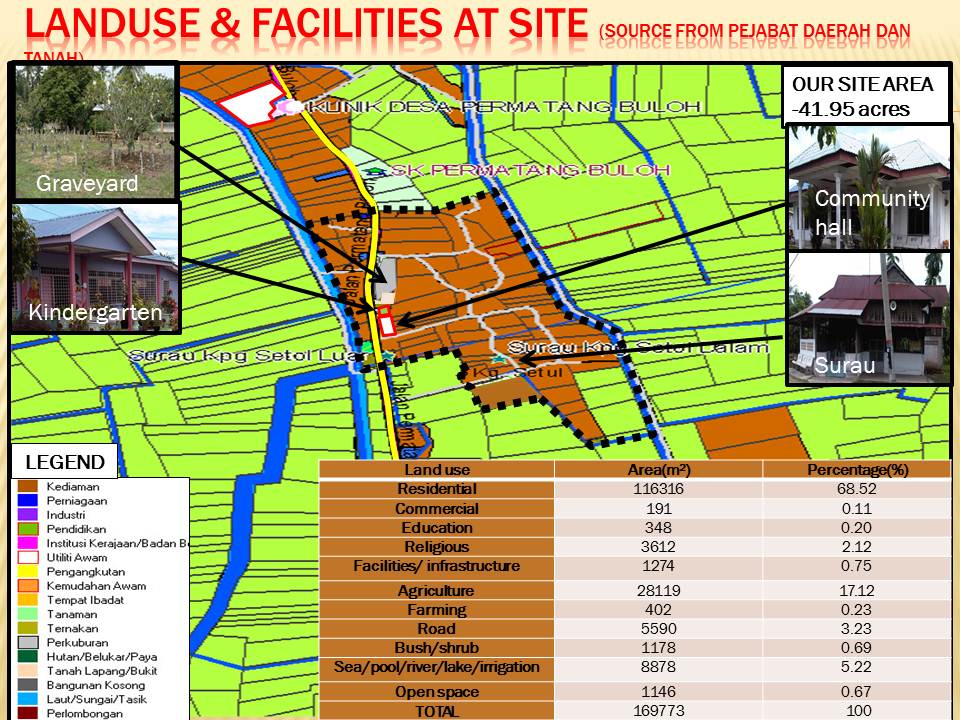
Our selected study area is kampung setol, kepala batas, which is a small village surrounded by paddy fields.  


As we are lacking of enough data and information for our site, this site analysis is not complete. 
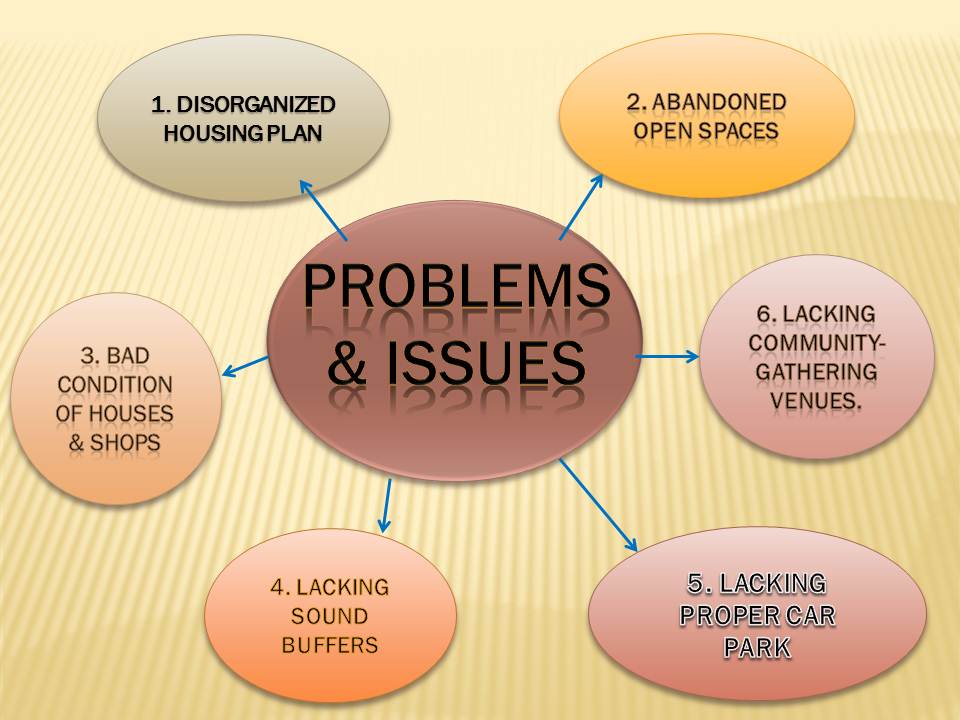
According to the lectures' comments, there still are errors in our slides:

  • Disorganized housing plan is not an issue or problem. This is because that houses are planned due to many kinds of reasons, this might be because of the government policy, or because of the different situation in certain places. 
  • The facilities should be shown in map in order to locate them and see the relationships between each other. Not only for the ones inside the study area, but also the ones nearby our site.


The informations and data which we are lacking of are:

  • population/ demography/ race or gender distribution
  •  issues and problems from social and economic points of view
  •  circulation/ road network/ hierarchy
  •  average income of residents there/ household monthly income
  •  facilities outside our site which can be used such as police station, bank...
  •  SWOT analysis